
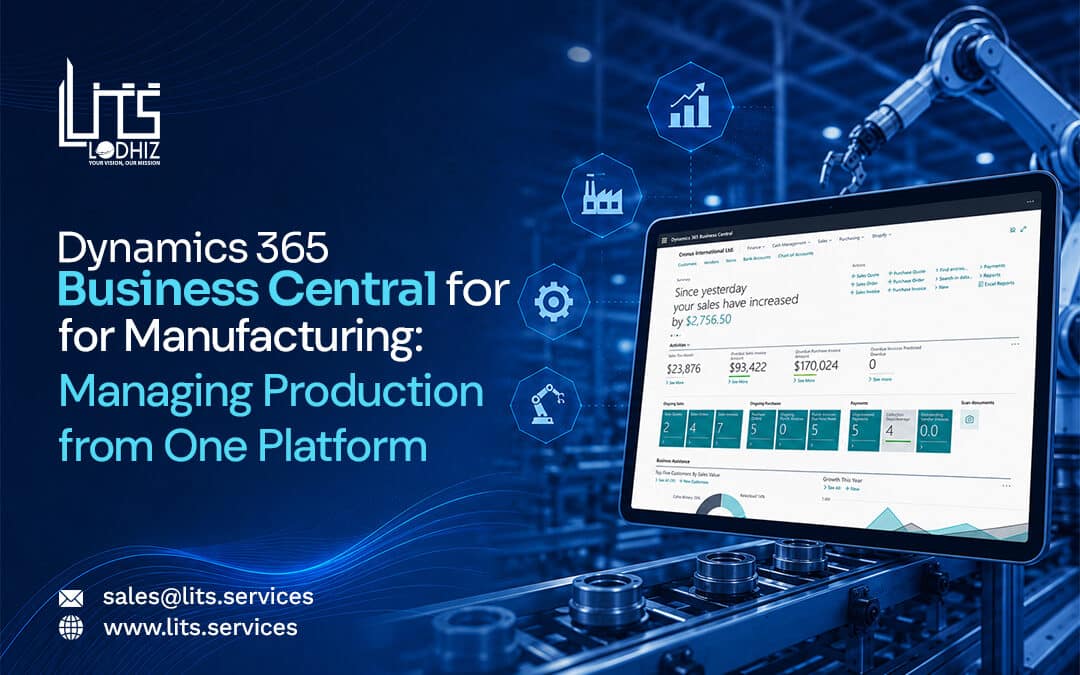
Making operations data-driven is no longer optional; production decisions must be based on real-time metrics rather than gut feelings or guesswork. The ideal ERP solution for this strategy is Microsoft Dynamics 365 Business Central, which unifies all operational data into a centralized platform for seamless production execution.
Because Business Central features a fully integrated manufacturing module, it provides complete visibility across the entire production. It brings together every critical process from planning and procurement to inventory, production, finance, and sales allowing enterprises to manage their entire operation from a single place.
Why Manufacturers Need an Integrated ERP Platform?
Manufacturers can no longer rely on traditional platforms. These outdated systems do not unify data, lack support for automation and analytics, and leave businesses unable to respond quickly to sudden market shifts or customer demands.
The modern environment demands agile solutions like Dynamics 365 Business Central for Manufacturing, which equips teams to handle unexpected disruptions, customer fluctuations, and sudden equipment failures.
With Dynamics 365 Business Central, manufacturers can:
- Manage inventory tracking across multiple warehouses in real-time.
- Gain comprehensive visibility into the active production floor.
- Utilize built-in demand forecasting and master planning tools.
- Track work centres, overall machine capacity, and routing steps.
- Support multiple manufacturing strategies, including discrete and process styles.
- Integrate smoothly with external Manufacturing Execution Systems (MES).
- Generate reports using BI tools.
As an integrated platform, Dynamics 365 Business Central provides manufacturing teams with comprehensive visibility into their production. From a single interface, teams can forecast demand, optimize production planning, track real-time floor activity, and extract the insights needed to make confident business decisions.
Because of this capability to manage production from a centralized ERP platform, Microsoft Dynamics 365 Business Central is rapidly becoming the solution of choice among leading manufacturers.
How Business Central Manufacturing Management Helps Manufacturers?
Demand planning:
Demand planning is the process of forecasting customer demand to optimize production pipelines. Based on these future projections, manufacturers can accurately synchronize their production schedules, procurement activities, and inventory levels to ensure that customers’ orders are fulfilled seamlessly and on time.
Demand planning promises precise production scheduling, optimal labor allocation, and data-driven inventory purchases. This proactive framework helps organizations eliminate carrying risks, drastically reduce operational costs, and maximize long-term customer satisfaction.
Material Requirement Planning
MRP in Business Central identify the materials needed to produce a product. It creates an impact on manufacturing process with proper production scheduling, planning, and inventory control. With MRP, right materials are available at the right time to meet production demands and customer requirements.
Capacity planning:
The Microsoft ERP solution supports capacity planning feature that utilizes real-time production data, including machine centres, personnel, manufacturing routing processes, and specific shift calendars. This ensures that manufacturers have the exact capacity required to fulfil customer demand efficiently and on time.
Real-time inventory insights
Efficient Planning is dependent on inventory levels. Business Central provides real-time visibility into inventory across various locations. This enable planning and inventory departments to make informed decisions on procurement and production.
In essence Business Central inventory management helps manufacturers:
- Optimize inventory levels
- Meet production deadlines
- Enhance resource utilization
- Streamline production processes
Business Central allows manufacturers for strategic planning to forecast demand, manage inventory levels, and optimize resource and production scheduling with AI-powered insights. These insights help them execute their production with precision to achieve desired outcomes.
Workorder management with Business Central
Manufacturers can efficiently create, assign, monitor and complete production tasks based on production needs. The system combines planning, inventory, and resource data into a centralized platform that helps with proper execution of production.
Workorder often referred to as production order includes what needs to be produced, in what quantity, the materials required to complete manufacturing, assigned machines, and the dates. Users can create work orders based on demand and forecasts.
Workorder management with Business Central benefits manufacturers in many ways, including:
- Enhanced production accuracy
- Automated inventory and resource scheduling
- Better collaboration
- Real-time visibility of job status
- Lower production costs and reduced errors
Enable smart production with connected factory
With Business Central, users can build a connected factory where machines, people, systems, and data are interconnected. Technologies such as IoT, cloud computing, and AI are leveraged to enable smart production through real-time visibility of the production floor, automation of key processes, and data-driven decision-making.
Key aspects of connected factory include:
- Seamless exchange of data between machines
- IOT sensors track performance, temperature, and output, and downtime
- Predict potential downtimes using analytics
- Users can access production and inventory data from any device, anytime, anywhere.
Achieve Smart Production with Dynamics 365 Business Central Implementation
Dynamics 365 Business Central for Manufacturing enables smart production by creating intelligent factories, building resilient supply chains, streamlining planning and inventory management, and delivering AI-powered insights.
Beyond supporting core shop-floor workflows, the ERP seamlessly integrates native modules for sales, finance, customer service, and broader supply chain management. By unifying these critical areas, it serves as a complete business management solution designed to build sustainable business growth.
To successfully navigate your Dynamics 365 Business Central implementation, partnering with an experienced Microsoft expert is essential.
LITS SERVICES delivers comprehensive Microsoft Dynamics 365 solutions tailored to your unique needs combining expert consultation, custom development, system integration, deployment, and thorough user training.
No matter how complex your production processes are, our dedicated D365 consultants adopt a proactive approach to implement your ERP system with a deep, thorough understanding of your daily manufacturing operations.
FAQ Section
How does Business Central benefits manufacturing operations?
Business Central encompasses planning tools which helps with precise production planning, job scheduling, production scheduling, demand forecasting, inventory management, and more. Users can create intelligent factories that leverages AI, analytics, and IOT to enhance production efficiency with real-time visibility.
Can I integrate Business Central with manufacturing systems?
Yes, Business Central seamlessly integrates with third-party manufacturing execution systems (MES) to manage and control the production processes.
What modules are supported in Business Central besides manufacturing?
Business Central integrates Dynamics 365 apps for managing sales, finance, customer service, and supply chain operations. Besides providing operational functionalities, the ERP leverages enterprise-grade AI, advanced analytics, and automation to streamline operations.