
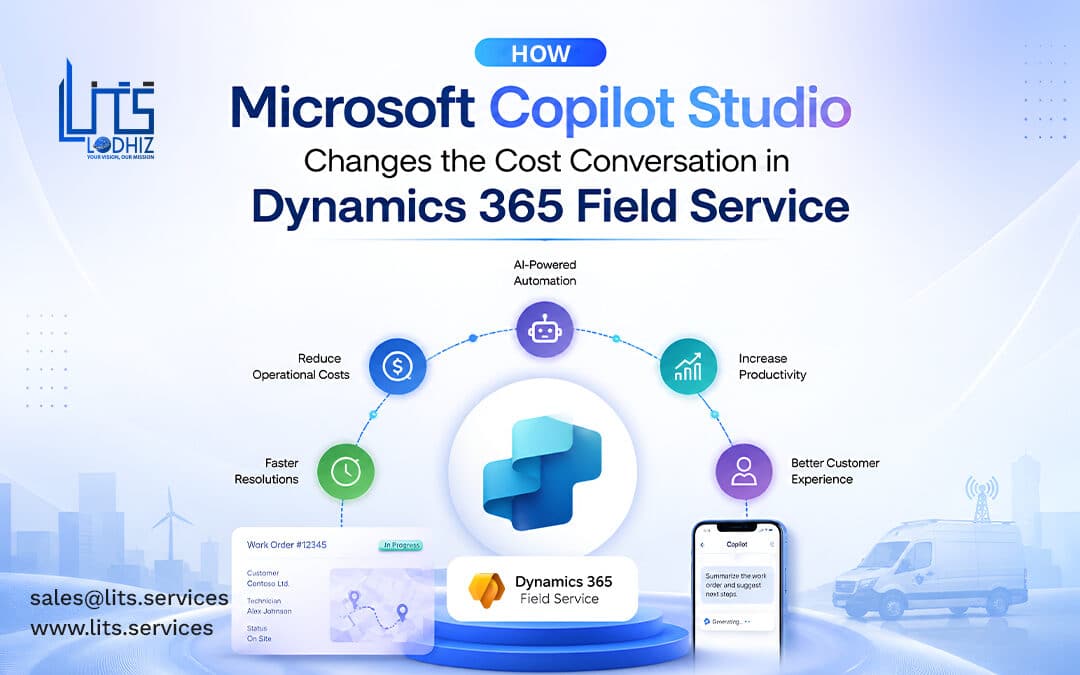
Field service operations are typically centered on the coordination of a mobile workforce, customer service requests, parts inventory, and scheduling. However, the reliance on advanced platforms like Dynamics 365 Field Service is creating a fundamental shift in how these onsite operations are delivered.
With features covering work order management, intelligent scheduling, asset management, and mobile empowerment, a Dynamics 365 Field Service implementation offers immense value.
But as we look toward field service software costs in 2026, is the investment truly worth it?
Organizations are now looking beyond simple licensing fees; the conversation has shifted toward how much time, effort, and operational cost a solution actually saves through automation and AI-driven efficiency.
This is where Microsoft Copilot Studio takes center stage for Dynamics 365 Field Service users. This AI-powered tool provides a significant advantage in driving cost savings.
Copilot Studio shifts the focus toward delivering productivity rather than simply worrying about the cost of licensing.
Traditionally, Dynamics 365 follows a per-user licensing model, meaning organizations must purchase a new license for every additional user as the team grows a model that can rapidly drive-up operational costs.
However, Copilot is changing this dynamic. Here is how that shift is happening.
The traditional cost model of Field Service Software
The cost model of Dynamics 365 Field Service is typically evaluated based on the expenses incurred in purchasing, implementing, and maintaining the system. More precisely, it covers licensing costs, implementation costs, and operational costs.
Licensing costs are the recurring subscription fees charged per user for accessing the software. These users can include technicians, dispatchers, and managers, meaning the total cost scales as the number of users increases.
Implementation costs refer to the expenses associated with deploying the system within an organization. This includes configuring workflows, integrating with other systems, customization, and training employees.
Operational costs refer to the ongoing costs of running field service operations. These may be influenced by factors such as manual data entry, scheduling inefficiencies, and errors in billing.
Traditionally, the cost conversation focuses on what organizations spend on the software. However, an often-overlooked factor is the cost of human effort involved in executing daily workflows.
Effect of Microsoft Copilot Studio with Dynamics 365
Field service organizations can now rethink how they evaluate cost when Dynamics 365 Field Service is integrated with Microsoft Copilot Studio.
Traditionally, software cost has been evaluated based on how many users need access, the cost per license, and the total subscription expense. This is known as a software-centric cost model.
However, the focus is now shifting toward a work-centric cost model, driven by Microsoft Copilot Studio. It enables organizations to focus on productivity – how much manual work can be automated, where automation can be introduced, and how much human effort can be reduced.
In this approach, the cost conversation is no longer limited to software spend, but also includes how much effort is required to complete day-to-day work efficiently.
How Copilot Studio Enables This Shift?
Microsoft Copilot Studio changes the fundamental nature of work through intelligent automation. It allows users to create AI agents that operate independently to execute actions across various field service scenarios.
Organizations can now deploy specialized agents for a wide range of critical tasks:
Proactive Maintenance: Custom agents can monitor IoT data in real-time. When an anomaly is detected, the agent can automatically create a work order, order necessary replacement parts, and assign the most qualified technician—all without human intervention.
Intelligent Scheduling: Instead of hiring more dispatchers, an AI agent can manage the complex task of dispatching technician batches. It automatically balances factors like technician skill sets, fuel costs, and real-time traffic to ensure optimal routing and eliminate scheduling disruptions.
Custom AI Assistants: To improve service delivery, users can build agents that act as on-site mentors. These agents can search content across Word and OneDrive to provide technicians with instant troubleshooting advice during a repair.
Comprehensive Customer History: Agents can pull relevant details from emails, Teams chats, and Excel files, giving technicians and managers a unified, 360-degree view of the customer’s history before they even arrive on-site.
By transforming Dynamics 365 Field Service into an action-oriented platform, Copilot Studio enables organizations to achieve massive savings not only in operational overhead but also in licensing costs through the power of end-to-end automation.
Ultimately, Copilot Studio provides a solution that eliminates repetitive human effort to save both time and cost shifting the focus from the total cost of software to the true value of the work delivered.
While you may consider alternatives such as Salesforce Field Service, it is important to note that licensing structures and AI capabilities differ significantly. However, given the massive cost advantage provided by Copilot Studio, a comparison of Dynamics 365 vs. Salesforce Field Service almost becomes secondary. The conversation has shifted from the price of a license to which platform delivers the highest agentic ROI.
When you are looking to accelerate your field service operations, a Dynamics 365 Field Service implementation is the most strategic move you can make. By leveraging intelligent AI agents, you can scale your service capacity without being held back by Field Service software costs in 2026.
This is how Microsoft Copilot Studio fundamentally changes the cost conversation. LITS SERVICES brings deep expertise as a Microsoft Dynamics 365 Solution Provider to implement a solution tailored specifically to your unique business needs.